
Two bedroom sets can look almost identical and still have very different construction. One may use timber for the frame and painted panels for the headboard. Another may have a wood-grain surface over a manufactured board. The photograph tells you about the style, but it cannot tell you everything inside the furniture.
When comparing MDF vs solid wood furniture at Furniture Hub or any other store, ask what each part is made from. Your choice should suit the piece, the room and your budget. A material name is a useful starting point, but the quality of the finished furniture depends on more than that label.
Is MDF or Solid Wood Better for Furniture?
MDF is worth considering for smooth painted panels and suitable indoor cabinetry. Solid wood is worth considering when natural grain, timber components and future repair options matter to you. Neither label guarantees a well-made product. Check the design, materials, joints, supports, hardware and finish before deciding.
A combination can also make sense. A furniture maker may use timber for certain frame parts and MDF for decorative panels. What matters is whether each material suits its job and whether the seller describes the construction clearly.
What Is MDF Furniture?
MDF stands for medium-density fibreboard. It is an engineered wood panel made using wood fibres and binders. Furniture makers can paint it or cover it with a decorative surface. MEDITE SMARTPLY describes these uses in its guide to MDF in furniture applications.
An MDF furniture label does not tell you the board grade, thickness or finish. Ask for those details, particularly when comparing two quotes. Also ask whether the specification applies to the entire item or only to certain parts, such as wardrobe doors or a headboard.
MDF, Veneer and Laminate Are Different Things
MDF is a core material. Veneer is a thin layer of real wood that may be applied over a core. Laminate is a manufactured surface covering. A wood-grain appearance alone does not prove that a piece is solid timber throughout.
Ask two separate questions: “What is the core?” and “What covers it?” Write both answers on the quotation. Terms such as “wood finish” describe appearance too loosely to settle the material comparison.
What Is Solid Wood Furniture?
Solid wood furniture uses timber components rather than fibreboard for the parts described as solid wood. However, a piece sold under that description may still have other materials in drawer bottoms, back panels or upholstered sections. Ask the seller to identify those parts instead of assuming they are all identical.
Wood species, drying, joinery and design all affect the finished result. A heavy item or an attractive grain pattern is not enough to judge construction. Open drawers, inspect accessible joints and request written details about the frame and supports.
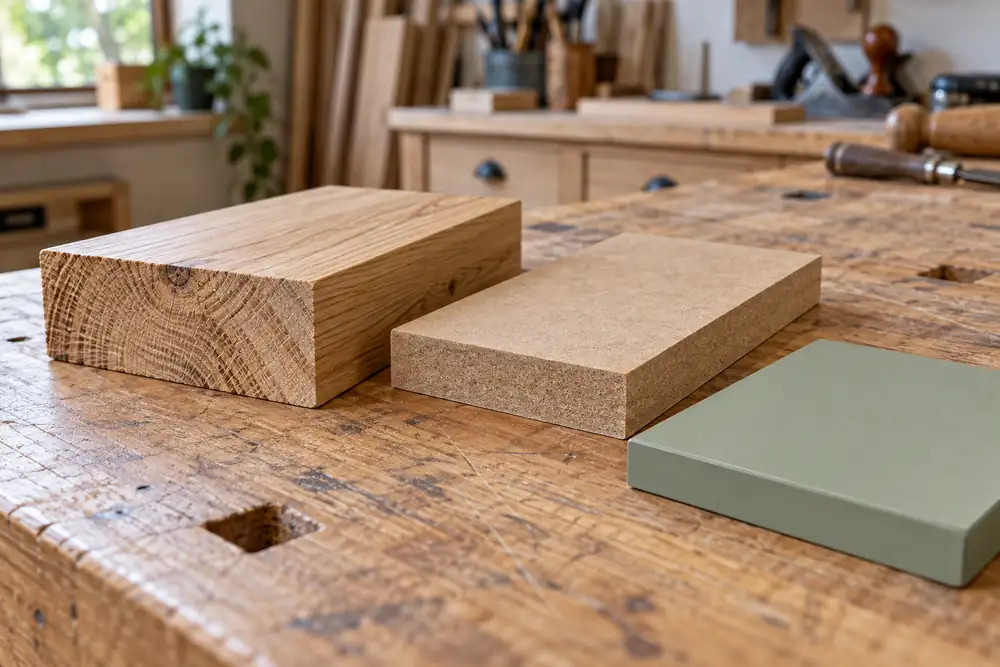
MDF vs Solid Wood: A Practical Comparison
Use this table to plan questions, then compare the actual products. Different grades and designs can change the result.
| Factor | MDF furniture | Solid wood furniture |
|---|---|---|
| Appearance | Often used for painted, laminated or veneered surfaces | Can display natural grain and variation |
| Specification | Ask for board grade, thickness, edge finish and support | Ask for species, component sizes, drying and joinery |
| Moisture | Check the board’s intended conditions; avoid prolonged wetting | Wood responds to moisture changes and also needs protection |
| Repairs | Possibilities depend on the coating and condition of the core | Some timber parts can be repaired or refinished, depending on damage |
| Price comparison | Include finishing, hardware and installation | Include species, workmanship, finish and installation |
| Buying decision | Assess the complete item and intended use | Assess the complete item and intended use |
Compare Strength by the Job Each Part Does
“Which is stronger?” is incomplete without knowing the component. A wardrobe door, a long shelf and a bed rail perform different jobs. Ask how the design supports weight and which parts carry the main load.
Ask for the recommended load for shelves and check the span between supports. For a bed, ask about the side rails, centre support, slats or platform and their connections. For a chair, look beyond the seat surface to the frame and joints.
When comparing bed sets for your home, separate decorative parts from load-bearing parts. A painted MDF headboard does not tell you how the mattress is supported. Equally, a solid wood headboard does not prove that the hidden frame is well designed.
Check Hardware and Assembly
Open and close the drawers and doors. Ask which hinges, runners and connectors are included, whether they can be replaced and how the item should be moved. If you expect to relocate often, discuss dismantling and reassembly before ordering.
Have the seller explain any wobble, sticking drawer or visible gap. Do not accept the material name as an answer to a workmanship concern.
Consider Moisture in the Intended Room
For furniture in Karachi, inspect the actual room rather than choosing by a city-wide rule. Is there a damp wall, a leaking window or a cabinet base that gets wet during mopping? Address those conditions before placing new furniture there.
Moisture-resistant MDF is a specific category, not a promise that the finished piece is waterproof. MEDITE’s guidance on moisture-resistant MDF distinguishes humid indoor conditions from prolonged water exposure. Confirm the product grade and how the maker will finish exposed edges and openings.
Solid wood also needs care. The Canadian Conservation Institute’s wood furniture guidance explains that wood takes up and releases moisture as conditions change. Do not assume that choosing timber makes leaks or repeated spills harmless.
Compare the Finish You Actually Want
For a clean painted look, ask to see a completed sample, including its edges and routed details. For a natural wood appearance, ask whether you are viewing solid timber, real veneer or a printed surface. Each can have a place in furniture, but the description should match the product.
Examine the finish under normal light. Look for uneven coverage, rough edges and inconsistent details. Confirm the approved colour or sample code in writing, especially for custom furniture.
Your choice may come down to appearance as much as material. A restrained painted wardrobe and a timber bed can work together without requiring every item in the room to have the same core or finish.
Compare Prices Using the Same Specification
MDF vs solid wood furniture prices in Pakistan cannot be reduced to one reliable percentage. Dimensions, materials, finishing, hardware, labour and delivery all influence a quotation. An elaborate painted piece may cost more than a simpler timber item.
Ask for two itemised quotes covering the same size and included pieces. Compare what changes between them. If the cheaper option uses different runners, thinner panels or fewer storage sections, the price difference is not just about MDF versus wood.
When browsing furniture for your home, shortlist by purpose and dimensions first. Then compare specifications and the total delivered price. Keep installation, stairs and assembly charges visible in the budget.
Think About Maintenance and Future Repairs
Ask for care instructions for the exact surface. Do not assume that all wood-looking furniture should be polished or oiled. Painted surfaces, laminates, veneers and timber finishes may need different methods.
Discuss likely repair options before buying. Can the maker replace a damaged door? Are matching handles available? Can a loose connector be serviced? These questions may be more useful than a broad promise that the piece will last a certain number of years.
Solid timber can sometimes allow refinishing or component repair, but the damage and finish still matter. With MDF, a surface blemish and a swollen core are different problems. Ask a suitable repairer to assess the item before sanding, repainting or applying filler.
Which Material Suits Your Purchase?
| Your priority | What to consider | What to confirm |
|---|---|---|
| Smooth painted wardrobe doors | A suitable MDF specification | Board grade, thickness, finish and hinge arrangement |
| Visible natural timber | Solid wood components | Species, actual component materials and approved finish |
| A bedroom set within a set budget | Mixed-material construction | Frame materials separately from decorative panels |
| Heavy storage | A design rated for the intended load | Shelf supports, fixings and maker’s load guidance |
| Furniture you may move repeatedly | Serviceable construction | Dismantling instructions and replaceable connectors |
There is no need to choose one material for your entire home. Match each piece to its use and insist on a clear specification.
Frequently Asked Questions
Is MDF furniture good for everyday use?
It can be suitable when the board specification, construction and finish match the intended job. Check supports, hardware and care instructions. The word MDF alone does not tell you whether a particular wardrobe, table or decorative panel is well made.
Is solid wood always better than MDF?
No. Solid wood may suit natural-grain designs and certain components, while MDF may suit painted panels and cabinetry. Compare the whole product. Poor joinery, unsuitable dimensions or weak hardware can undermine furniture regardless of its main material.
Is MDF waterproof?
Do not assume it is. Standard and moisture-resistant products have different intended uses, and the latter does not automatically allow prolonged water exposure. Ask for the exact grade, finishing requirements and care instructions for the completed item.
Which is better for a bed, MDF or solid wood?
Check the load-bearing frame and mattress support separately from the headboard and decorative panels. Ask about rails, slats, centre support and connections. A bed may combine materials effectively, but its specification and construction need to suit the intended use.
Can MDF be used for wardrobe doors?
Yes, suitable MDF products are used for wardrobe doors, including painted designs. Ask about the grade, thickness, door dimensions and hinge arrangement. Also check how edges are finished and whether the room has moisture problems that need attention first.
How can I tell whether furniture is solid wood?
Ask for a component-by-component specification and inspect accessible edges and undersides with the seller. Veneer can display real wood grain over another core, so appearance alone is not conclusive. Keep the agreed material description on the invoice or order.
Is MDF the same as particleboard or plywood?
No. MDF uses wood fibres, particleboard uses wood particles, and plywood uses bonded veneer layers. They are different panel products with different grades and applications. Ask which board is actually specified rather than accepting “engineered wood” as the complete description.
Which material is easier to maintain?
The surface finish and use conditions matter as much as the core. Follow the instructions for the particular item, clean spills promptly and avoid unsuitable products. Ask how to care for painted, laminated or veneered parts separately if the furniture combines finishes.
How long will MDF or solid wood furniture last?
There is no reliable lifespan based on the material name alone. Construction, use, room conditions, maintenance and repair options all matter. Compare written warranty terms and available after-sales support instead of relying on an unsupported number of years.
What should I ask before ordering custom furniture in Pakistan?
Confirm dimensions, materials for each major part, finish, hardware, included pieces and total delivery cost. Record the completion estimate, payment stages and warranty terms. Approve a sample or drawing so the maker has a clear reference for the result you expect.
Choose the Specification, Not Just the Label
Start with the job the furniture must do. Then compare the component materials, construction, finish and written order details. Whether you choose MDF, solid wood or a combination, those checks give you a clearer basis for your decision than a showroom label alone.